
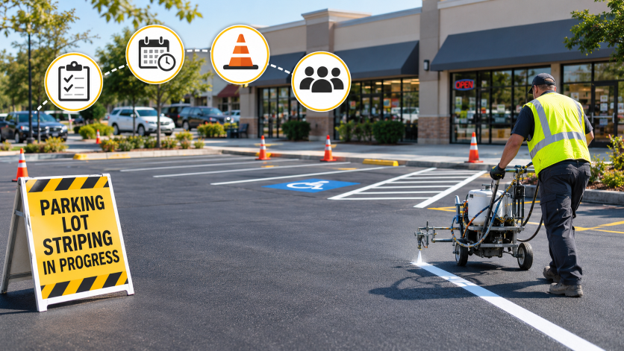
Parking lot striping looks simple until the crew shows up during your busiest hour. A blocked entrance costs sales, frustrates tenants, and sends customers to the lot next door. Most of that disruption comes from planning gaps, not from the striping itself.
This post covers how to set the scope, pick a time window, phase the work, and what to settle with fresh line striping contractors before the first line goes down.
Start With What Actually Needs to Change
Faded markings cause confusion, and confusion in a parking lot leads to badly parked cars, blocked lanes, and safety concerns for drivers and pedestrians. Before you request quotes, walk the lot and decide what the project covers. Is it a straight repaint of the existing lines, or does anything about the layout need to change?
Write down what you see: faded stalls, worn arrows, missing stop bars, unclear loading zones, fire lanes, and crosswalks. That list becomes the scope every contractor quotes against, which makes the quotes easier to compare.
Decide Whether the Layout Stays the Same
Repainting an existing layout is the simplest job. If you want to add stalls, change traffic flow, or reorganize a lot that has changed use over the years, ask for a marked layout plan before any paint goes down. Mistakes found after painting cost more to fix than mistakes found on paper.
If the lot has accessible spaces and access aisles, have them checked against the ADA Standards for Accessible Design and any state or local rules before you repaint them. Do not assume the old layout was correct just because it has been there for years.
Decide on Custom Markings Early
Reserved parking, branding elements, and safety messaging often call for custom stencils. Yellow Dawg Striping produces custom stencils tailored to a property, and the stencil stays with you for future use. That matters for planning: settle the wording and placement early, and you will not need to remake the stencil at the next restriping.
Choose a Time Window That Matches Your Traffic
The best time to stripe is when your lot is quietest, and only you know your traffic pattern. Check your own sales or visitor data. A retail center has different slow hours than an office park, and a warehouse has different ones again.
Weather matters too. Rain can push a job back, and humidity can slow drying. Published dry-time guidance ranges from under an hour to a day or more, depending on the material and the weather. So ask your contractor for the actual dry time of the material they plan to use, and build in a buffer.
Weekdays, Weekends, or Overnight?
| Option | Often suits | Watch for |
|---|---|---|
| Overnight or early morning | Retail, medical, restaurants | Lighting, security access, noise limits |
| Weekends | Offices, industrial sites | Weekend events, church or school use nearby |
| Section by section | Occupied multi-tenant properties | Longer overall duration, more coordination |
Which of these a contractor can offer varies, so ask early.
Phase the Work So Part of the Lot Stays Open
You do not always have to close the whole lot. Splitting it into zones keeps entrances, accessible spaces, and delivery routes open while one zone is being striped.
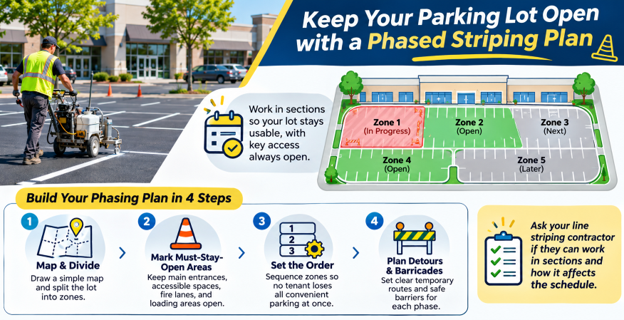
A trade publication profile of a large multi-tenant center shows how far this can go. The contractor divided the lot into 27 workable areas and grouped them into phases of up to seven areas each, spread out so stores kept access. They built the plan around each tenant's store hours and revised it several times until every tenant could live with it (For Construction Pros, 2017). Most lots are far smaller, but the method scales down.
To build your own phasing plan:
Draw a simple map of the lot and divide it into zones.
Mark the zones that must stay open: main entrances, accessible spaces, fire lanes, and loading areas.
Order the zones so no tenant loses all convenient parking at once.
Plan detours and barricades for each phase.
Ask fresh line striping contractors whether they can work in sections and how that changes the schedule.
Tell People Before the Cones Go Out
A good plan still fails if nobody knows about it. Tenants, staff, delivery drivers, and regular customers all need notice. Many property managers send it a week or two ahead on larger sites. Smaller lots may need less.
What Your Notice Should Include
● The dates and hours of the work
● Which zones close and when
● Where people should park instead
● Who to call with questions
Sample Wording
The south lot will be closed Saturday from 6 a.m. to noon for restriping. Please use the north lot during that time.
Post the same message on site a few days before the work, and update your website or Google Business Profile if access to your entrance will change.
What to Ask Fresh Line Striping Contractors Before You Hire
A clear scope up front prevents most surprises.
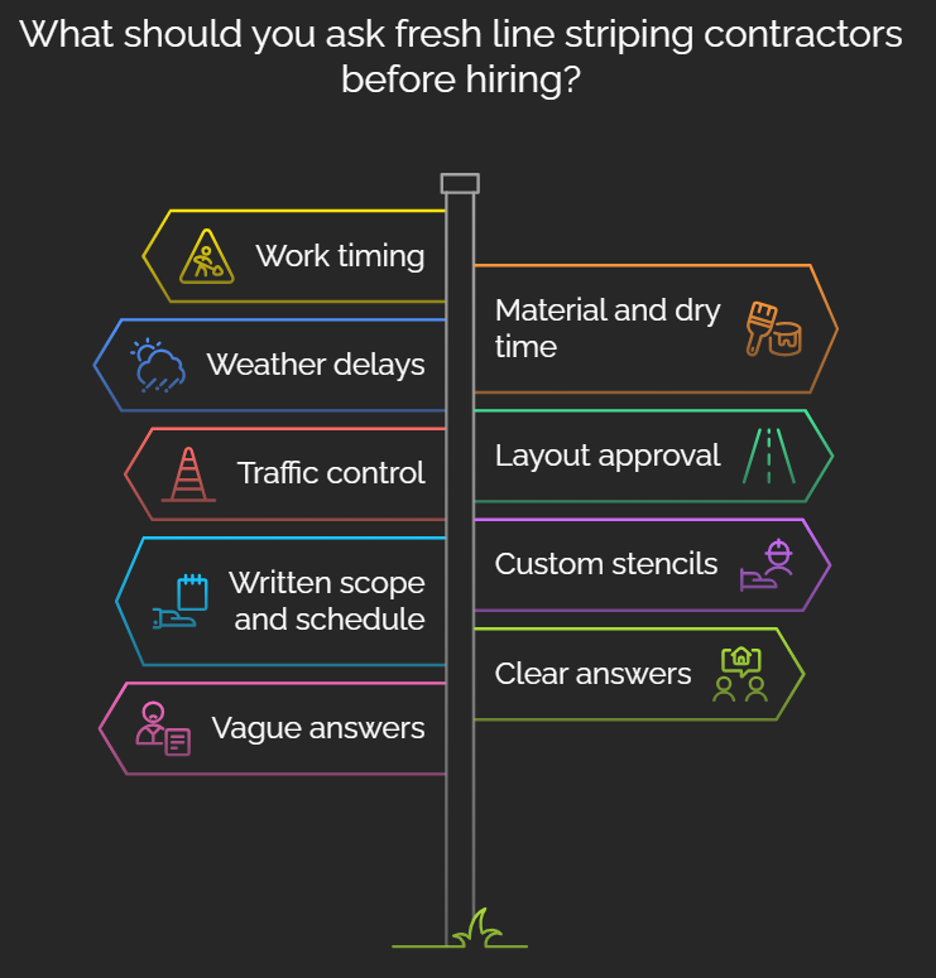
Bring these questions to every conversation:
● Can the work be done off-hours, on a weekend, or in sections?
● What material will you use, and what is its dry time?
● What happens if the weather delays the job?
● Will the layout be marked on the pavement for approval before painting?
● How do you handle traffic control and detours?
● Can you make custom stencils, and who keeps them?
● Will I get the scope and schedule in writing?
Clear, specific answers are a good sign. Vague ones are a reason to keep looking.
A Simple Planning Timeline
| When | What to do |
|---|---|
| 4 weeks before | Walk the lot, set the scope, collect quotes |
| 3 weeks before | Choose a contractor, approve the layout and stencils |
| 2 weeks before | Send notices and finalize the zones |
| 1 week before | Check the forecast and post signs |
| Work day | Mark closed zones, keep access routes clear |
| Day after | Walk the lot and note any touch-ups |
Shorten this for a small lot. Lengthen it for a large, busy property.
What Can Go Wrong
A few problems show up again and again.
● Cars left in a closed zone slow the crew down, so mark zones early and remind tenants the day before.
● Layout errors found after painting force rework, so approve the plan first.
● Cracks and damaged pavement should be repaired before restriping, so new lines are not painted over problems.
Ask your contractor how repairs fit into the schedule.
FAQs
-
It depends on lot size, layout complexity, surface prep, and weather. Ask your contractor for a written schedule that includes dry time and a backup date.
-
Often yes, if the work is phased or done off-hours. The right approach depends on your traffic pattern and the contractor's availability.
-
Not always. Some jobs can be done section by section so entrances and key spaces stay open. Ask whether a phased schedule is available and how it changes the timeline.
-
Yes, repairs generally come first so new lines are not painted over damaged pavement. Ask your contractor how repairs affect timing.
The Final Words
If your lines are faded and you want a plan that fits your business hours, Yellow Dawg Striping can review your lot and talk through fresh line striping and custom stencil options.
When you compare fresh line striping contractors, start with the questions above.