What Are Parking Guidance Pavement Markings and Why They Matter
Most drivers don't think about parking lot markings until they're missing. A driver circles the same row twice, stops short at a blind corner, or drifts into a lane meant for pedestrians. None of that is really about parking. It's about guidance, or the lack of it.
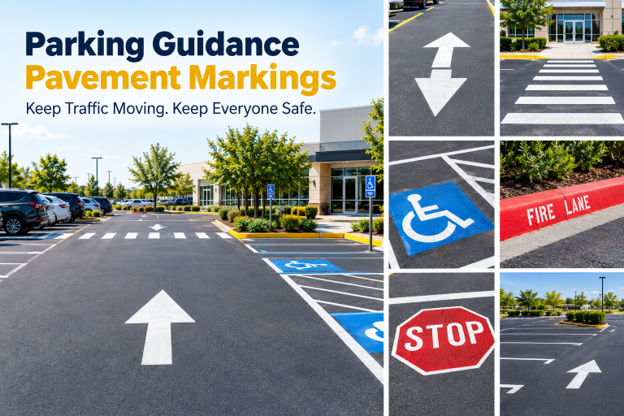
Parking guidance pavement markings are the lines, arrows, symbols, and zones that tell drivers and pedestrians where to go and what to avoid. When they're done well, people barely notice them. When they're faded, missing, or poorly planned, a lot starts to feel disorganized even if nothing structural has changed.
What Counts as a Guidance Marking?
Guidance markings cover more than just the lines around individual spaces.
They typically include:
Directional arrows showing one-way flow or entry and exit points
Crosswalks connecting parking areas to building entrances
Stop bars and yield lines at intersections within the lot
Curb markings that flag no-parking zones or pedestrian paths
Each of these plays a specific role. Arrows manage vehicle movement. Crosswalks manage pedestrian movement. Curb markings prevent vehicles from blocking access points. On their own, they're small details. Together, they're what makes a lot feel predictable to use.
Why Lots Become Hard to Navigate
A parking lot rarely loses its guidance markings all at once. Paint wears unevenly, and the areas with the most traffic, like main drive aisles and entrance points, tend to fade first. By the time a property owner notices the problem, drivers may have already adjusted their behavior, cutting through rows, ignoring one-way arrows, or parking in areas that were never meant for parking.

Unmarked Bays Create Parking Confusion
A few common causes:
High traffic volume in main aisles wearing down paint faster than surrounding areas
Weather exposure, particularly sun and freeze-thaw cycles, breaking down markings over time
Layout changes, such as new landscaping or building additions, that were never reflected in updated markings
Original markings that didn't account for how the lot is actually used day to day
None of these causes are unusual. They're part of normal pavement wear. The issue is that once guidance markings disappear, the lot loses the visual cues that keep traffic organized.
How Guidance Markings Support Accessibility and Safety
Guidance markings and accessibility markings work together more than people realize. A properly marked accessible space is only useful if the access aisle beside it is also visible, and if the route from that space to the building entrance is clearly defined. ADA compliant parking lot striping accounts for this connection, pairing accessible space symbols with the access aisles and crosswalks that lead to entrances.
The same overlap applies to fire lane parking lot striping. Fire lanes rely on clear curb markings and visible signage to stay unobstructed, which depends on drivers understanding where they can and cannot park. When guidance markings are worn or inconsistent, fire lanes and accessible routes become harder to maintain in practice, even if the original layout was compliant.
Clear markings can help reduce confusion for drivers and pedestrians alike, though no striping project can eliminate every risk on its own. What consistent parking guidance pavement markings can do is make it easier for people to understand where they should and shouldn't be, which supports a safer, more orderly property overall.
When It's Time for Professional Striping
Not every faded line requires an immediate response, but a few situations usually call for professional assessment:
Directional arrows or stop bars have faded to the point where drivers can't reliably see them
Crosswalks near entrances are difficult to distinguish from surrounding pavement
The property has added or changed traffic patterns since the last striping project
Accessible spaces or fire lanes are due for a compliance check
A professional striping contractor can evaluate the current layout, identify where guidance markings have worn thin, and determine whether the existing plan still fits how the property is used. In some cases, that means repainting existing lines. In others, it means adjusting the layout to better match traffic patterns that have changed over time.
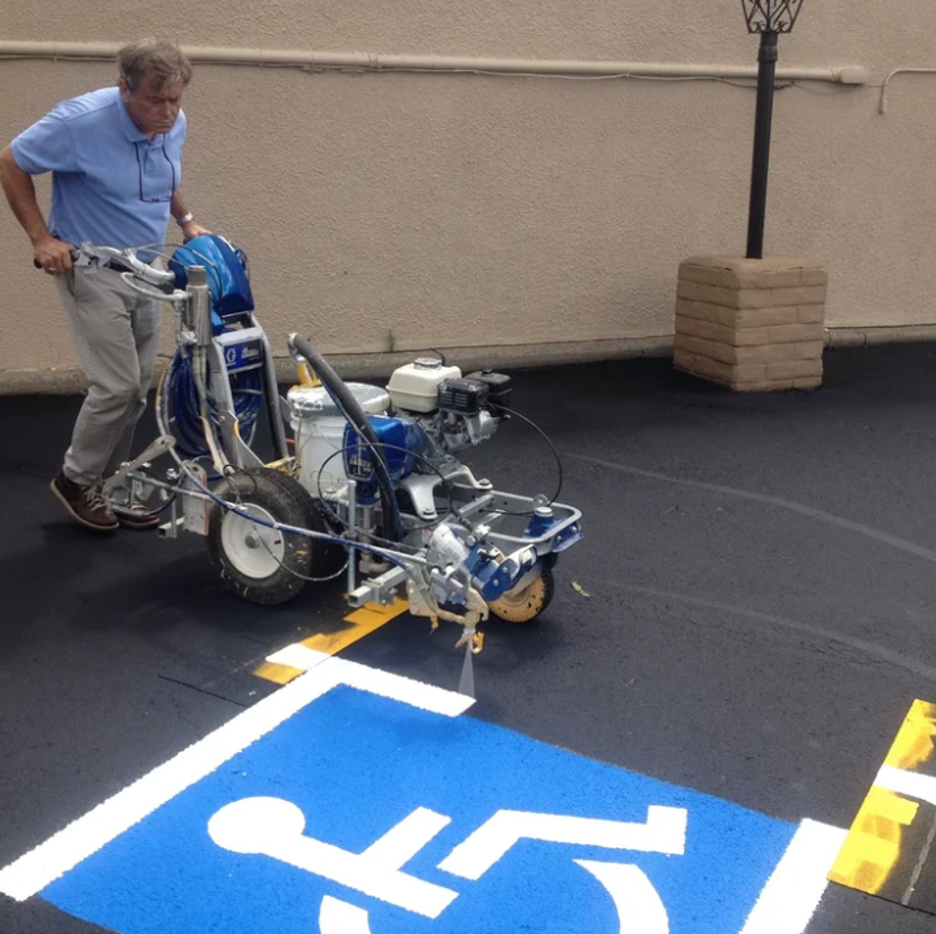
Yellow Dawg Striping works with property owners to assess parking lots and apply parking guidance pavement markings, along with ADA compliant striping and fire lane markings, using layouts built around how the property actually functions. If your lot has started to feel harder to navigate than it used to, that's usually the first sign worth checking into.
FAQs
-
They're the arrows, crosswalks, stop bars, and curb markings that direct vehicle and pedestrian movement through a parking lot. Together, they make traffic flow predictable instead of leaving drivers to guess.
-
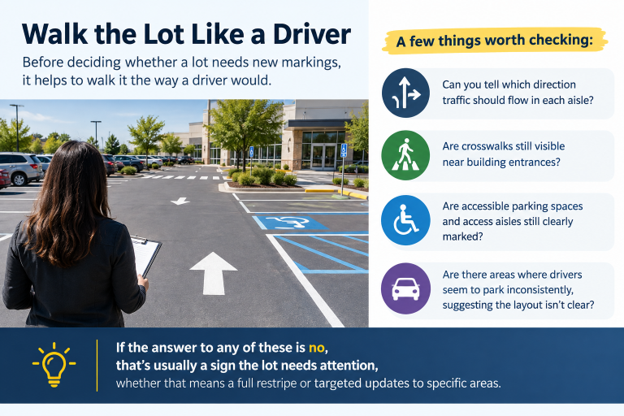
Walk the lot the way a driver would. If directional arrows are hard to see, crosswalks near entrances have faded, or drivers seem to park inconsistently, that's usually a sign the markings need attention.
-
Yes, in an indirect way. Accessible spaces only work if the access aisle beside them and the route to the building entrance are also clearly marked. Faded guidance markings can make an otherwise compliant layout harder to use in practice.
-
In many cases, yes. A professional assessment can identify whether the lot needs targeted updates, like refreshing arrows and crosswalks, or a full restripe.
Conclusion
A parking lot doesn't need to be falling apart to feel disorganized. Often, it just needs clearer guidance. Directional arrows, crosswalks, and curb markings work quietly in the background, and their absence is usually what makes a lot feel confusing to navigate.
If your property's markings have started to fade or no longer match how the lot is actually used, that's worth a closer look. Yellow Dawg Striping can assess your lot and recommend the guidance markings that fit how your property functions today.